
Before You Go
Get Your FREE Home Cleaning Guide
Simple action items on how to make your home safer- today!

No products in the cart.
No products in the cart.
Gain clearer insight into potential mold exposure in your environment and its possible impact on the body
Mold exposure is not always easy to identify. A home may look clean, smell normal, and still contain hidden moisture concerns or mold-related contamination that could affect the indoor environment.
Certain mold species can also produce mycotoxins, which are toxic compounds that may enter the body through inhalation, skin contact, or ingestion. Testing only the home or body may provide part of the picture, but combining environmental mold testing with urine mycotoxin testing can offer broader insight.
The Dust Test and MycoTOX Profile® Bundle is designed to assess mold species in household dust and mycotoxins in the body, supporting more informed conversations about the possible connection between the home environment and ongoing health concerns.
Learn More
Mold-related symptoms can vary from person to person and may overlap with many chronic, complex, or difficult-to-explain health concerns. Because of this, combined testing may be considered when symptoms persist and exposure within a home, workplace, vehicle, or water-damaged building is suspected
Healthcare practitioners may consider environmental mold and urine mycotoxin testing for individuals experiencing or being evaluated for concerns such as:
Home and body testing does not replace medical evaluation or a professional mold inspection, but it may provide additional information when assessing possible environmental contributors.

Mold and mycotoxins can come from several sources, including water-damaged buildings, vehicles, workplaces, and certain foods. Because contamination may be hidden behind walls, underneath flooring, inside HVAC systems, or within porous materials, environmental exposure can be difficult to recognize through sight or smell alone.
The effects of exposure may also depend on
For people with known or suspected water-damaged building exposure, testing the home and body together may help reveal environmental patterns while also assessing whether Mold-Related Toxins may be present inside the body.
Testing the home can help identify mold species and contamination patterns within the environment. Testing the body can help assess whether certain mycotoxins are being detected through a urine sample.
Together, The Dust Test and MycoTOX Profile® can help healthcare practitioners and individuals better understand possible connections between environmental findings, health history, and symptom patterns
Results may support a more informed next-step plan, especially when combined with professional medical guidance, a detailed review of the building, and further investigation when potential mold sources are suspected.
Mold particles and mycotoxins may enter the body through several routes, including:
Common food sources that may be affected include
Indoor exposure may occur when mold affects drywall, paint, wallpaper, carpeting, insulation, furniture, HVAC systems, and other porous materials. In humid environments or water-damaged buildings, excess moisture can support mold growth and the release of spores, fragments, volatile compounds, and potentially mycotoxins.
Household dust can collect particles over time, making it useful for screening broader mold conditions within the home.
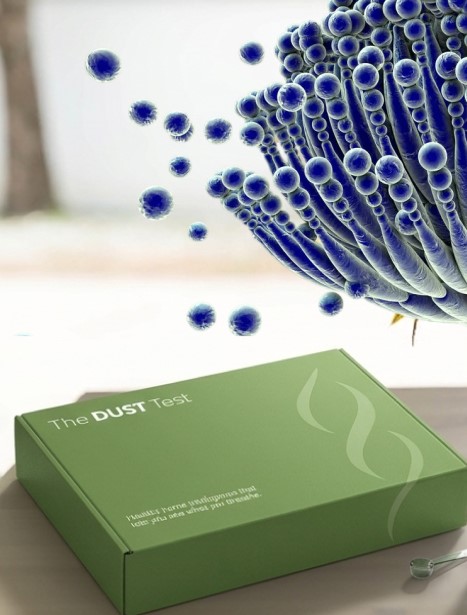
The Dust Test uses advanced PCR technology to analyze household dust for 36 mold species. Customers collect a dust sample using the materials provided, return it to the laboratory, and receive results through a secure online portal.
The MycoTOX Profile® uses liquid chromatography tandem mass spectrometry, also known as LC-MS/MS, to measure mycotoxins with a high level of specificity. The urine-based test can detect low levels of certain compounds and uses creatinine correction to account for differences in fluid intake.
Together, the tests provide two complementary perspectives: what may be present within the home and what may be detected inside the body.

The Dust Test is designed to assess 36 mold species found in household dust and provide information about environmental mold levels and patterns.
The MycoTOX Profile® from Mosaic Diagnostics is a comprehensive urine-based assessment of 11 different mycotoxins, including:
By reviewing both sets of findings, individuals and practitioners may gain a more complete understanding of possible mold exposure.
The results can help guide conversations about environmental investigation, professional inspection, healthcare support, and other appropriate next steps.
Mold exposure is not always obvious. Important clues may be hidden within past water damage, household dust, humidity, building materials, or symptoms that change depending on the environment.
The Dust Test helps assess the home for mold species and environmental contamination, while the MycoTOX Profile® helps evaluate mycotoxins detected through urine testing.
Together, these assessments can provide an additional layer of insight for individuals trying to understand whether their environment may be connected to ongoing health concerns.
The bundle helps move the investigation beyond guesswork by providing information from both sides of the potential exposure picture: the home and the body.


If You Suspect Mold Exposure May Be Affecting Your Home Or Health, The Dust Test And MycoTOX Profile® Bundle Can Provide Valuable Insight Into Mold Species Within Your Environment And Potential Mycotoxins Inside The Body.
Order the BundleBelow is a list of all analytes included in the test along with a brief description.
Aflatoxins: AFM1
An aflatoxin of concern, AFM1, is a hydroxylated metabolite of AFB1 and is secreted in the milk of both humans and animals.
Ochratoxins: Ochratoxin A
Ochratoxin A (OTA) which is the most prevalent, toxic, and clinically relevant fungal toxin of this mycotoxin group. While it has been associated with numerous negative health impacts, the kidney has been noted to be its main target organ – and studies indicate its association with nephrotoxicity in humans and animals.
Trichothecenes: Roridin E (ROE), Verrucarin A (VRA)
Tricothecenes are extremely potent inhibitors of protein synthesis and have been described to have wide-ranging negative systemic effects including immunotoxicity (immunosuppression), gastrointestinal toxicity, neurotoxicity, and dermatologic manifestations.
Zearalenone: Zearalenone
The main toxic effect of Zearalenone relates to its endocrine disruptive capabilities and as such, resultant negative reproductive effects in humans and animals.
Chaetoglobosin (CHA)
Chaetomium globosum is frequently isolated from materials found in water-damaged buildings – and is often referred to as ‘black mold.’
Enniatin B (ENB)
ENB has been shown to have endocrine disrupting properties as well as the ability to cross the blood brain barrier in in-vitro assays.
Gliotoxin (GTX)
Airborne Aspergillus fungal spores are ubiquitous in many environments, making potential exposure to gliotoxin common. Gliotoxins have been found on linoleum flooring and wallpaper in water damaged buildings, as well as silage and other animal food stocks.
Mycophenolic Acid (MPA)
MPA is used as an immunosuppressive drug for the prevention of transplant rejection in the form of sodium mycophenolate (Myfortic™, Novartis) and a pro-drug, mycophenolate mofetil (CellCept™, Roche) – and as a result, its levels may be elevated on diagnostics in patients using these pharmaceuticals.
Sterigmatocystin (STC)
Sterigmatocystin is a precursor of aflatoxin B1 in fungi capable of producing aflatoxins. Despite the similarity of chemical structure of these two mycotoxins, Sterigmatocystin has been noted to be a less potent carcinogen than Aflatoxin B1 (AFB1). It is classified as a Group 2B carcinogen by the International Agency for Research on Cancer.
Citrinin (CTN)
Exposure to CTN has been linked to the development of nephropathy, which is caused by CTN’s ability to increase the permeability of mitochondrial membranes in the kidneys. Rat studies have demonstrated that CTN is carcinogenic. Furthermore, several studies have linked exposure to CTN with a suppression of the immune response.
MosaicDX offers pediatric collection bags with adhesive tape for pediatric patients who have not been toilet trained. These bags can be used to collect urine from infants or young children.
Please refer to your test’s specific Test Preparation and Instructions for more information regarding the potential effects of medications, foods, and supplements on this test. Please consult your healthcare provider prior to making any changes to your medications.
Mycotoxins are low molecular weight, secondary metabolites of fungal (mold) compounds which are increasingly recognized as a global health threat given their role in precipitating both acute and chronic adverse health outcomes.
Acute mycotoxin effects are characterized by rapid onset and toxic response in the target organ most affected by the offending agent.
As an example, consumption of large doses of aflatoxins can result in life-threatening, acute poisoning (aflatoxicosis) due to detrimental impact on the liver.
Acute mycotoxin effects are more frequently observed in economically poorer global areas where sub-optimal food cultivation, harvesting, and storage practices are common; malnutrition is a constant presence; and a poor regulatory environment exists.
Chronic mycotoxin effects are characterized by lower exposure doses over longer periods of time – and symptoms attributed to chronic mycotoxin exposure are wide-ranging in their impact on an array of physiologic systems and functions.
Currently, there are no established guidelines for retesting mycotoxins after intervention. However, some healthcare providers recommend retesting at 3-6 months, 12 months, and annually as part of a wellness screen. Individuals with severe mold and mycotoxin-related illnesses may require more frequent testing.
If you need help getting started, submit this form or give us a call at (888) 668-MOLD (6653).
"*" indicates required fields
Expert insights on mold, indoor air quality, and healthier homes. Practical tips, real answers, and new resources delivered weekly.
"*" indicates required fields
Before You Go
Get Your FREE Home Cleaning Guide
Simple action items on how to make your home safer- today!